
Someone types “who is a good agency for this in my city?” into ChatGPT, Gemini or Perplexity. The assistant names three or four businesses. Is yours one of them? That is the whole question behind AI visibility.
In short: AI visibility (also called GEO, short for Generative Engine Optimization) is how often, and how correctly, AI assistants mention and recommend your brand when people ask them questions. It builds on good SEO rather than replacing it. Nobody can guarantee a mention, but you can make your brand far easier for AI tools to find, understand and trust.

If you have heard the word “GEO” a few times and nodded along without being fully sure what it means, you are in good company. Most founders we talk to are in the same place. The jargon is new, the tools keep changing, and a lot of what is written about it is either hype or too technical to use.
So this is the plain version. What it is, how it differs from SEO, how AI assistants actually pick their sources, a self-check you can run today without paying anyone, and where an agency like ours genuinely helps (and where it doesn’t).
What AI visibility actually means

Think of the old way people found businesses: they searched, saw ten blue links, and clicked one or two. Increasingly, they ask an AI assistant instead and read a written answer that already names a few options.
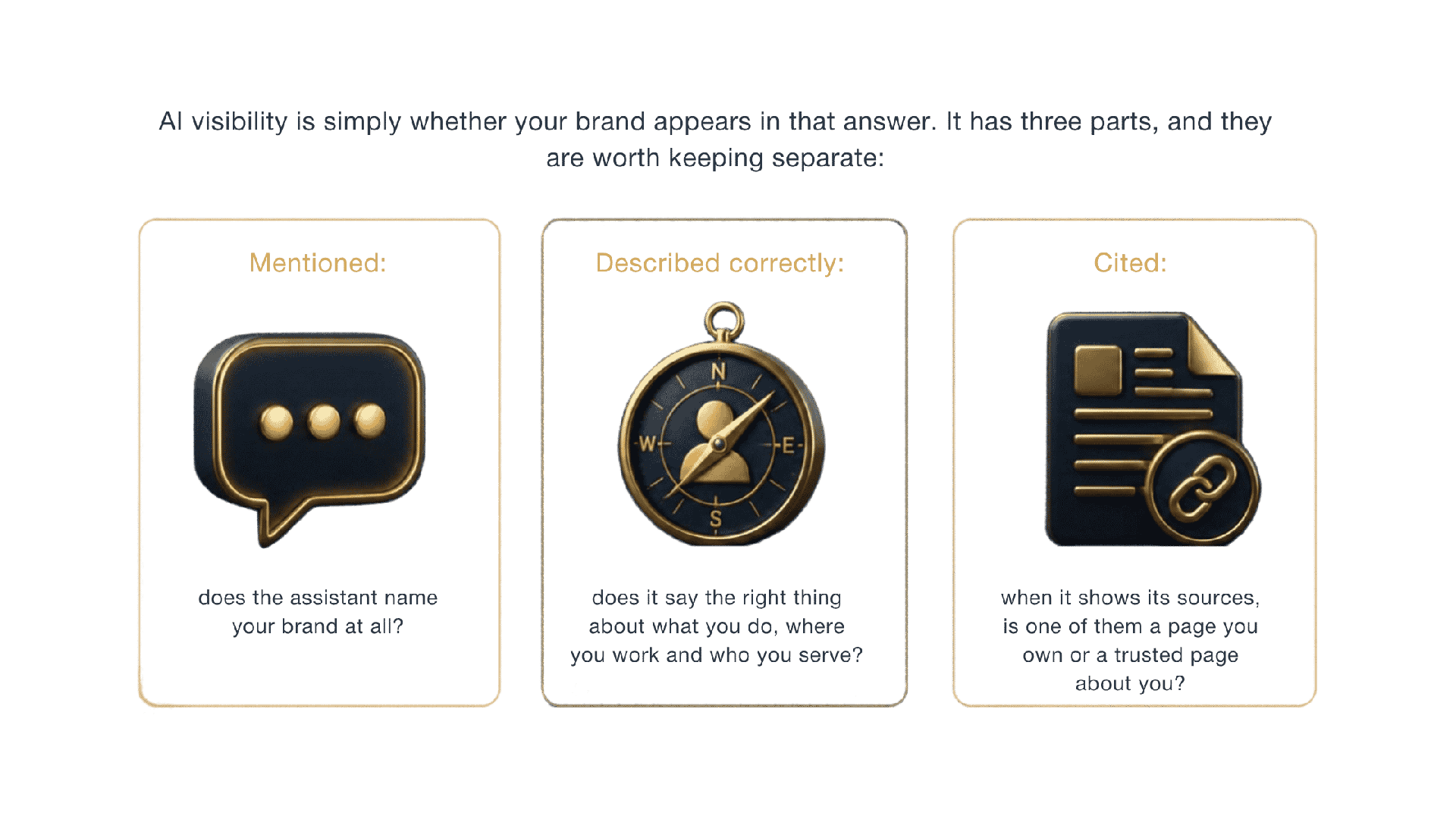
A brand can be mentioned and described badly. Another can be described well but never cited. The goal is all three.
SEO vs GEO, explained without the jargon
Here is the easiest way to hold the difference. SEO helps your page rank in a list of results. GEO helps your brand get included inside an answer. Same raw material (your website, your reputation, what the web says about you), different finish line.
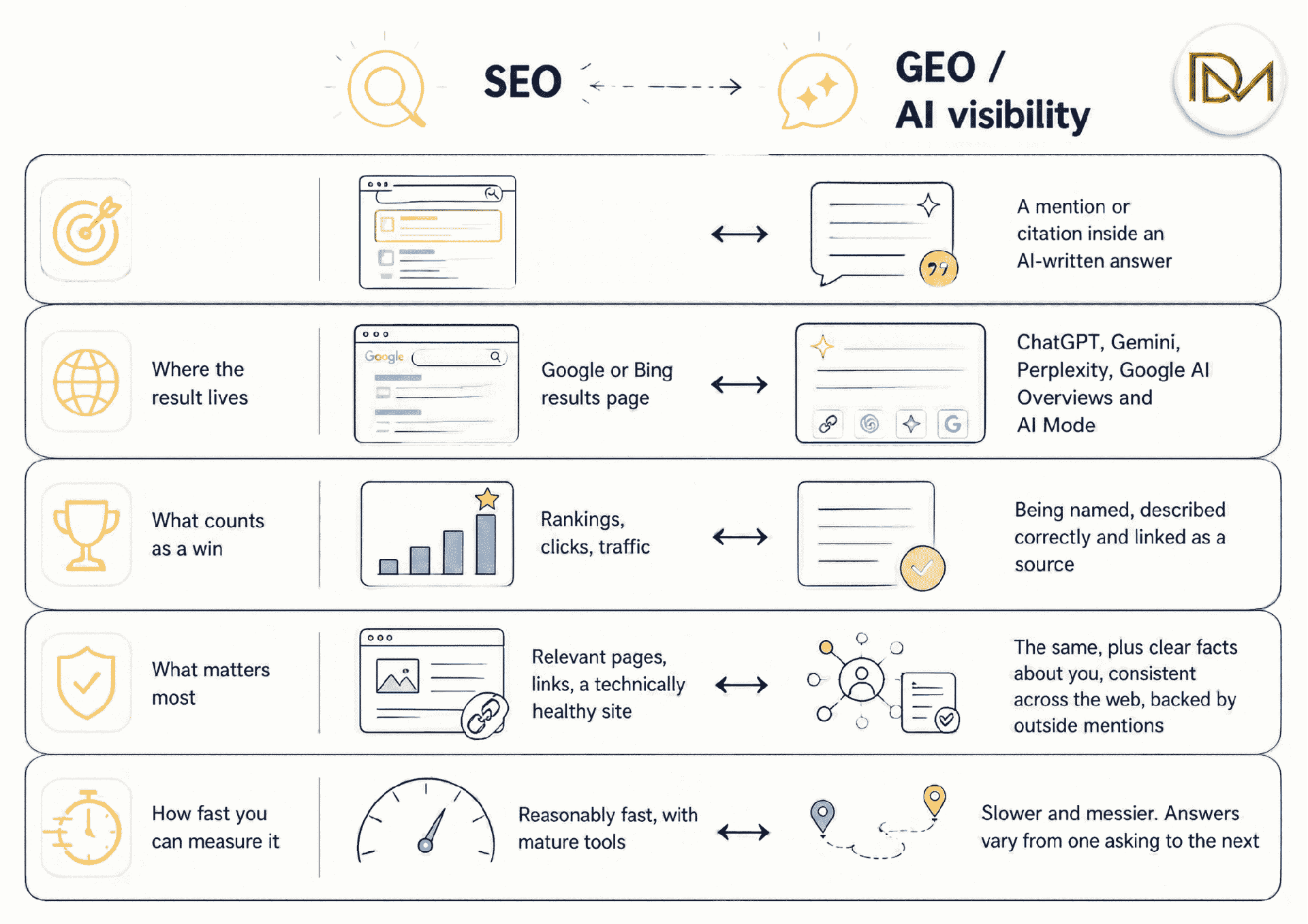
The most important line in that table is the fourth one. The foundations overlap heavily. Google itself says there are no extra requirements or special optimizations for its AI Overviews and AI Mode beyond standard SEO practice: a page needs to be indexed and eligible to show in Search with a snippet.
So if someone tells you that SEO is dead and GEO is a secret new trick, be careful. The truth is quieter. GEO is SEO’s foundations plus a sharper focus on being clear, being consistent and being talked about.
How AI assistants actually get their answers
Nobody outside the AI companies knows the exact recipe, and anyone who claims to is guessing. But the broad shape is well understood. An assistant usually answers from one of two places, and often a mix of both.
1. What it learned during training
Large language models are trained on huge amounts of text. If your brand showed up often, and consistently, in the sources that went into training, the model may “know” you. This route is slow. You cannot update it on a Tuesday afternoon, and you cannot see inside it.
2. What it looks up right now
Most assistants can also search the live web before answering. This is the route you can influence, because it depends on pages that exist today. The major players publish how their crawlers work:
- ChatGPT: OpenAI uses a crawler called OAI-SearchBot to help sites appear in ChatGPT search results, and a separate one, ChatGPT-User, when a person asks a question that needs a page fetched. These are set separately from GPTBot, which relates to training. Details are in OpenAI’s crawler overview.
- Perplexity: PerplexityBot surfaces and links sites in its results, and Perplexity-User fetches pages to cite them when someone asks a question. See Perplexity’s crawler page.
- Google AI Overviews and AI Mode: these can run several related searches behind the scenes (Google calls this “query fan-out”) and pull in a wider, more varied set of supporting links than a normal search. Google explains it in its guidance on AI features and your website.
The practical meaning is simple. If an AI tool cannot reach your pages, cannot understand them, or finds that the rest of the web says something different about you, you are less likely to be used as a source.
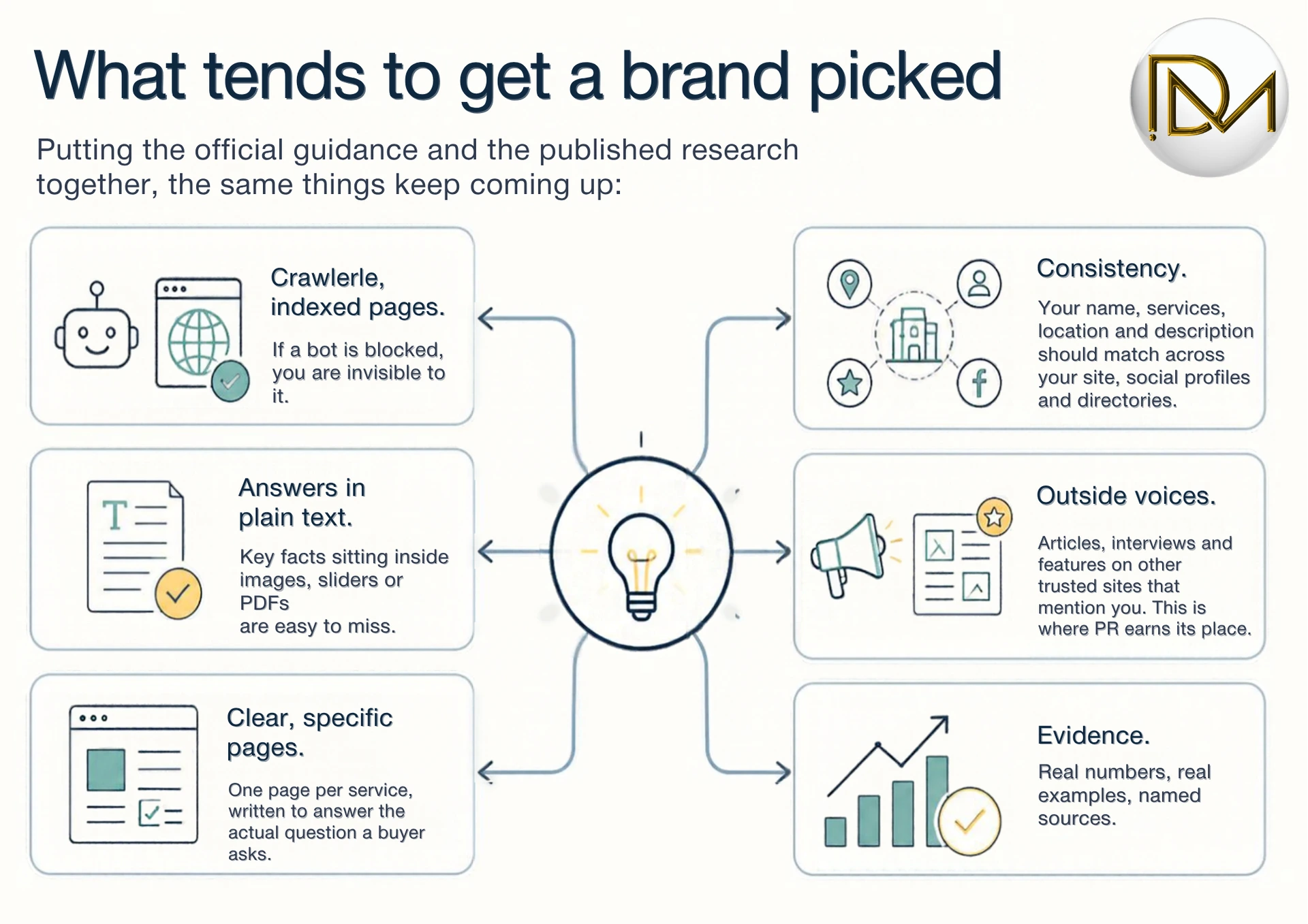
A note on the research. A paper published at KDD 2024, “GEO: Generative Engine Optimization”, tested ways of changing web content to see if AI answers would use it more. The authors reported visibility gains of up to 40% for methods like adding statistics, quotations and citations to sources, while classic keyword stuffing did poorly. That was a controlled test on a research benchmark, not a promise for any single business. But the direction is useful: specific, well-sourced writing beats repeating keywords.
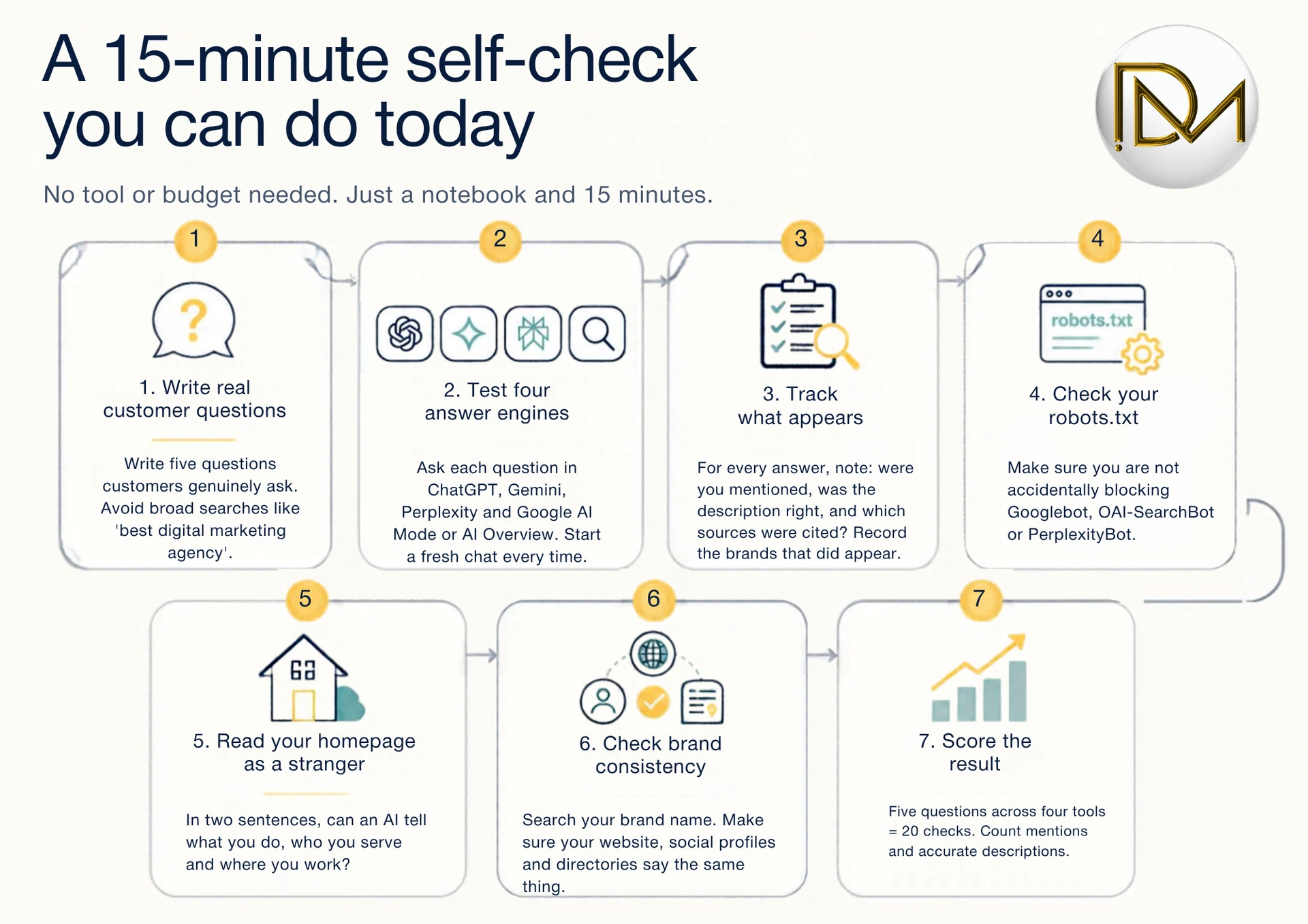
Run it again in a month. Answers shift from one asking to the next, so look for a trend and not a single result. If you score close to zero, that is not a failure. It just tells you where to start.
Be careful with one thing: any tool or agency that promises a guaranteed place in ChatGPT or Gemini answers is promising something nobody controls. These systems change, and they vary by question. We would rather tell you that now than after you have paid.
What actually moves the needle
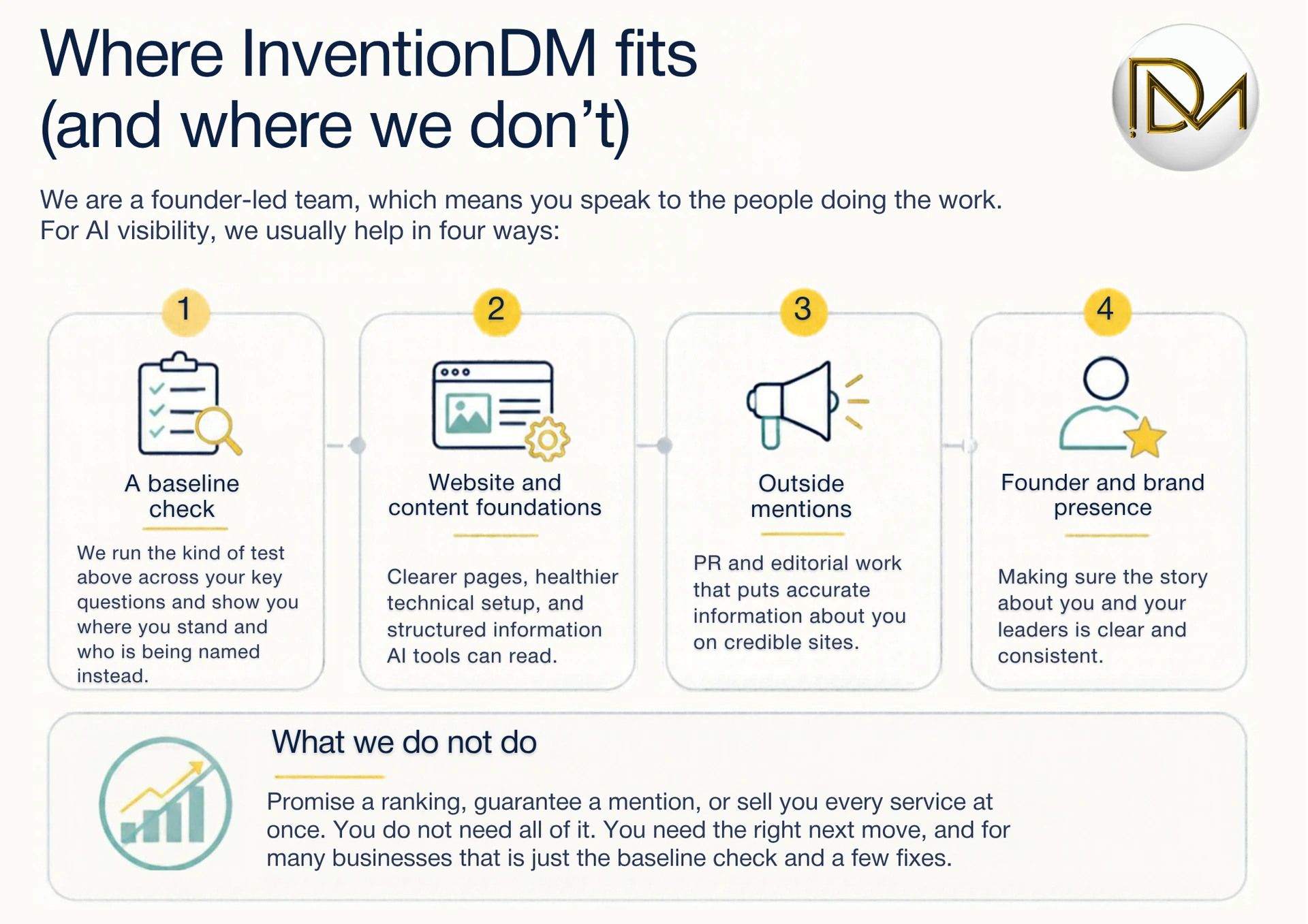
Here is the work we would do first, in roughly this order. None of it is glamorous. All of it compounds.
Fix the foundations on your own website
Make sure your important pages load fast, are indexed, and put the key facts in text. Give each service its own clear page. Add structured data where it fits, and make sure it matches what is visible on the page. For brand details, the Organization type on schema.org is the standard place to begin. If your site is slow, dated or hard to read, that is part of the same job. Our website development and redesign work often starts here, and our SEO, GEO and AEO work builds on top of it.
Write pages that answer real questions
Open with the answer, then explain. Use the words your buyers use. Add real numbers, named examples and sources you can point to. This is the part that connects most directly to the research above.
Get talked about in the right places
AI assistants lean on what trusted outside sources say about you, not only what you say about yourself. A feature, an interview or a founder story on a credible publication does double duty: it builds trust with human readers and gives AI tools another solid page to draw from. That is the logic behind our PR and media services and our personal branding work for founders. Publication and placement availability always depends on the campaign and the publisher, so we plan this case by case.
Keep your story consistent
Use one clear description of your business everywhere. Same name, same services, same location, same founder details. It is boring and it works.
Look at real examples
If you would like to see how we approach different industries, our case studies show the kind of work behind the logos.
Common questions
Is GEO replacing SEO?
No. The foundations overlap, and Google’s own guidance says standard SEO practice applies to its AI features. Think of GEO as SEO plus a stronger focus on clarity, consistency and outside mentions.
Do I need special files or markup for AI?
Google says you do not need AI-specific files, markup or special schema for its AI features. Keep your pages crawlable, your key information in text, and any structured data matching what is visible on the page.
How long does it take to see a change?
It depends on how much needs fixing and how quickly crawlers revisit your pages. Technical fixes can show up sooner. Reputation and outside mentions build more slowly. Measure over weeks and months, not days.
Can anyone guarantee that ChatGPT will mention my brand?
No. Answers vary by question and change over time. Be wary of anyone who guarantees a specific result.
Should I block AI crawlers?
It is your call, and the controls are separate. For example, OpenAI lets you manage search visibility and training with different crawlers. If you want to appear in AI answers, do not block the search crawlers by accident.
Not sure where you stand?
Send us the situation, not a service name. Tell us who you serve and which questions you wish AI assistants would answer with your name in them. We will tell you honestly what is worth fixing first.