
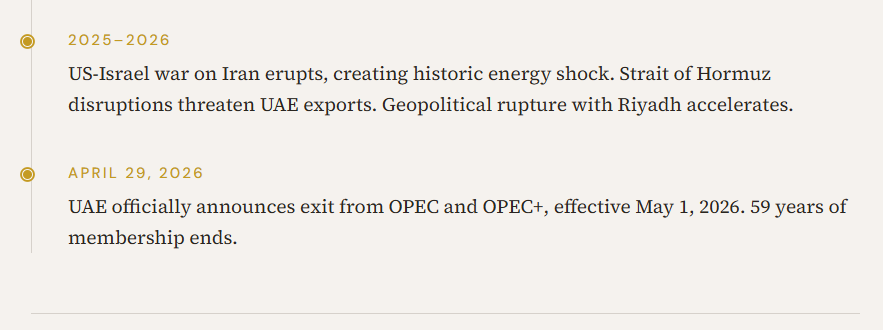
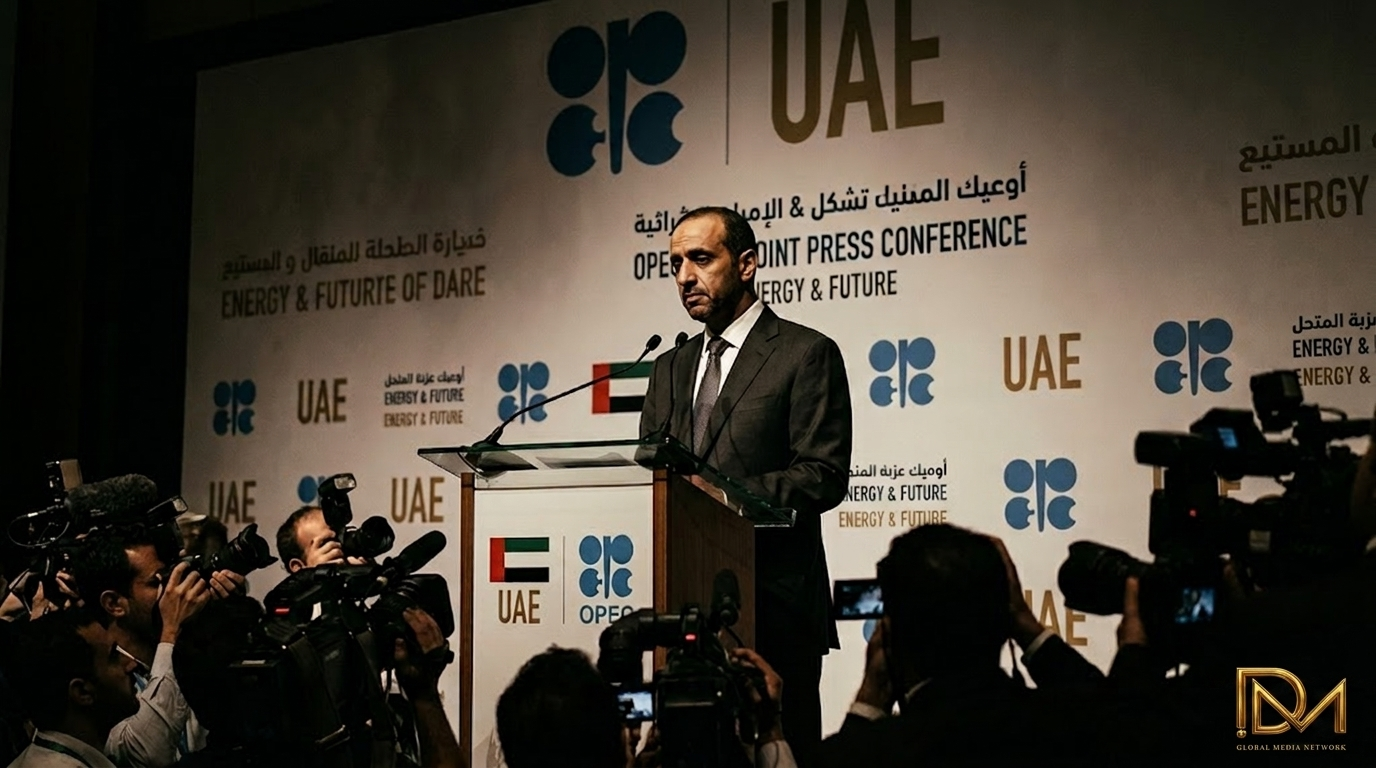
On April 29, 2026, the United Arab Emirates announced what many in the energy world had quietly suspected was coming for years: it was leaving OPEC and OPEC+ effective May 1, 2026.
The move sent ripples across oil markets, geopolitical strategy rooms, and business boardrooms worldwide. But here is the truth: most coverage has told you what happened. InventionDM is going to tell you everything.
What Exactly Is OPEC, And Why Did It Exist?
Before you can understand why the UAE left, you must understand what OPEC actually is, what power it holds, and why that power has always been contested from within.
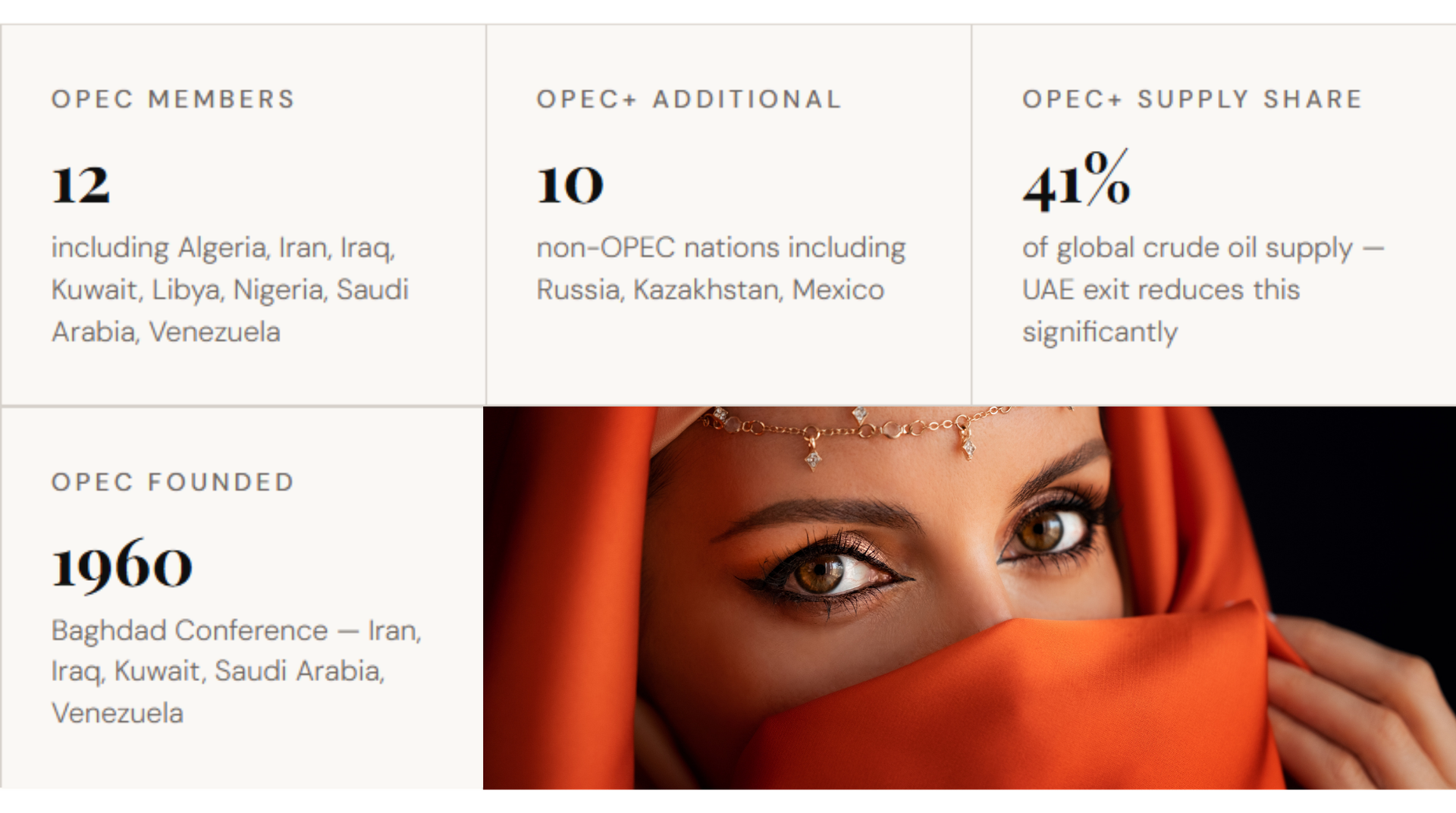
Most people know OPEC as "the oil cartel." That is partially correct but dangerously incomplete as an understanding. The Organization of the Petroleum Exporting Countries was born in Baghdad in September 1960, founded by five nations: Iran, Iraq, Kuwait, Saudi Arabia, and Venezuela. The reason? Retaliation.
In 1959, the United States imposed mandatory import quotas on crude oil, shutting out Persian Gulf producers from the lucrative American market. Oil companies, largely Western and multinational at the time, then unilaterally cut the prices they paid to producing nations. The producing countries had no collective voice. OPEC was their answer: a permanent intergovernmental organization to coordinate petroleum policies and ensure fair pricing for their sovereign resource.
"The formation of OPEC marked a turning point toward national sovereignty over natural resources, a declaration that oil-producing nations, not Western corporations, would decide the price of their earth."
— Economic historians on OPEC's founding philosophy
How OPEC's Core Mechanism Works
OPEC's primary tool is the production quota system.
The logic is simple: if you control how much oil enters the global market, you control the price. Oil is a commodity, reduce supply, prices rise; flood the market, prices fall.
The OPEC Conference, comprising oil ministers from all member states, meets typically twice per year to set an overall production ceiling.
That ceiling is then divided among member countries using a quota allocation formula based primarily on each country's production capacity, with secondary consideration for oil reserve size and economic factors. Each member receives a specific number: how many barrels per day they are allowed to produce.
Here is the critical insight most people miss: this quota system is politically negotiated, not mathematically derived.
Countries with ambitions to produce more, but constrained by a lower quota, face a permanent tension between national economic interest and collective discipline.
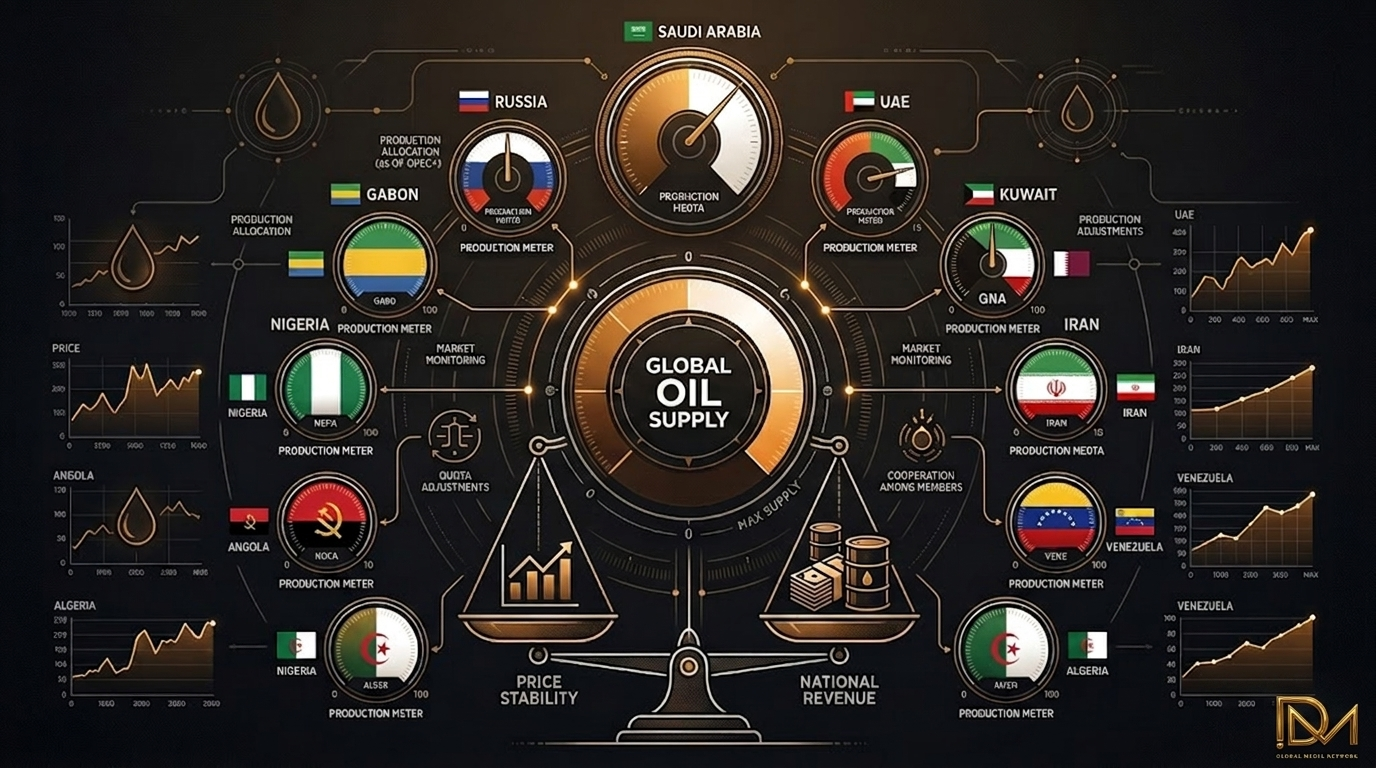
OPEC's quota allocation has always been a balance between collective discipline and individual national ambition.
The Chronic Problem: Cheating
From OPEC's earliest days, members regularly exceeded their production quotas.
The economic logic is brutal: if everyone else is cutting production to hold prices up, and you quietly produce more, you benefit from the higher price and sell more volume. You are a free rider.
Historically, OPEC members have exceeded their quotas by 10 to 15 percent on average during normal market conditions, compliance only improves when prices collapse and everyone faces existential financial pressure simultaneously.
Saudi Arabia, as the largest producer with the most spare capacity, has historically served as the "swing producer", adjusting its own output to compensate for others' cheating and defend the price.
This arrangement has repeatedly created resentment: why should Riyadh bear the burden of others' discipline failures?
What Is OPEC+ And Why Was It Created?
OPEC+ is not simply a bigger version of OPEC. It represents a structural admission that OPEC alone could no longer control global oil prices in the 21st century.
In 2014,
something alarming happened from OPEC's perspective: American shale oil production surged massively.
The United States, which had been a declining oil producer for decades, suddenly had access to vast unconventional oil reserves through hydraulic fracturing ("fracking") technology.
US production rose from under 6 million barrels per day in 2011 to over 9 million by 2015, devastating OPEC's pricing power.
OPEC's initial response was aggressive: Saudi Arabia flooded the market with cheap oil to drive shale producers out of business (since shale has higher production costs, typically requiring $50–60 per barrel to break even). It partially worked, oil prices crashed below $30 per barrel by early 2016.
But shale proved resilient, adapting and cutting costs. OPEC was hurting itself as much as its target.
The solution was OPEC+, formalized in late 2016. Ten non-OPEC oil-producing nations critically including Russia, but also Azerbaijan, Kazakhstan, Bahrain, Brunei, Malaysia, Mexico, Oman, South Sudan, and Sudan agreed to coordinate production cuts with OPEC.
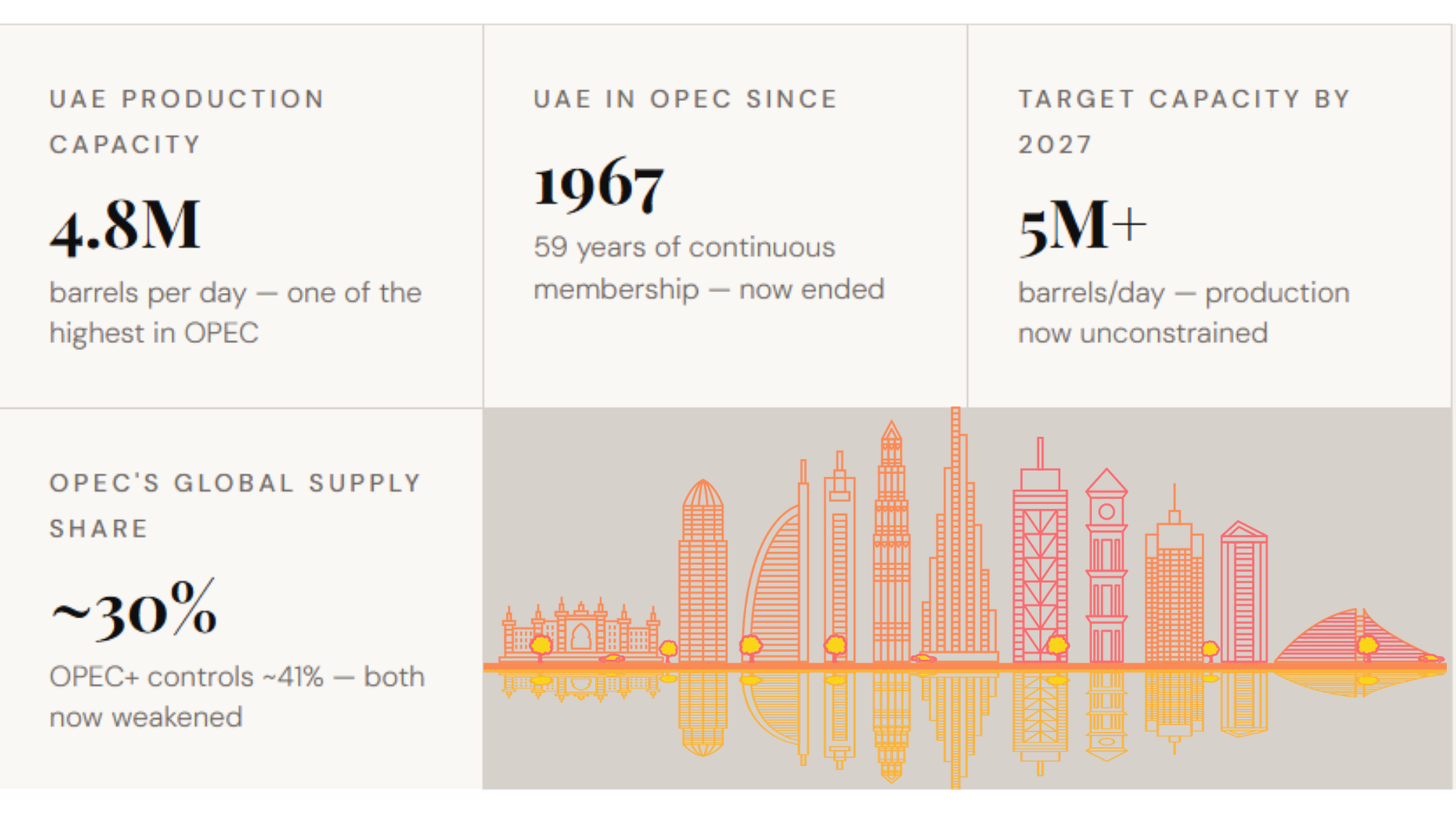
Together, OPEC+ controls approximately 41 percent of global oil supply. This expanded coalition gave the group far greater market influence than OPEC alone.
The UAE's Long and Complicated Relationship with OPEC
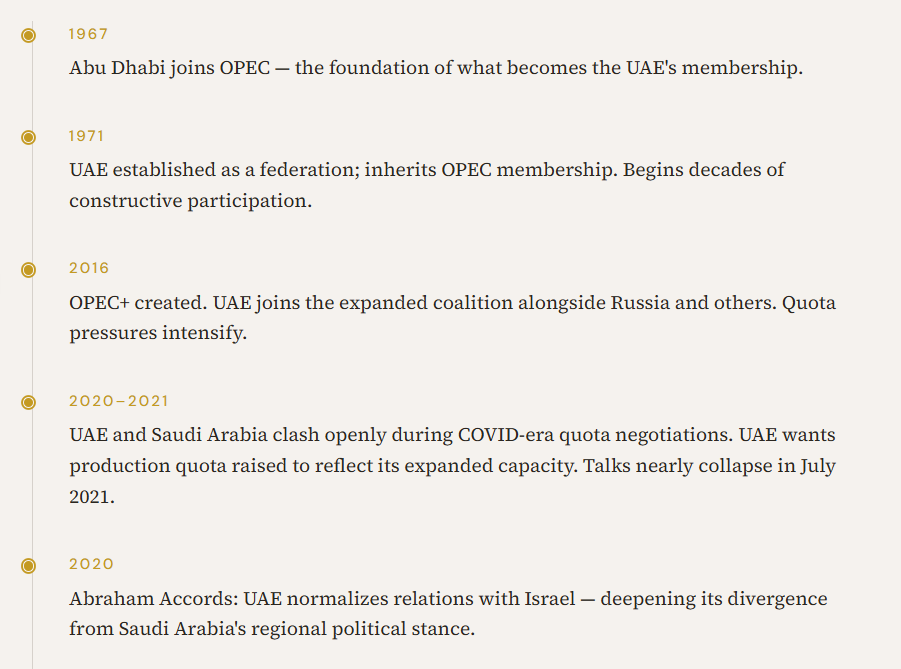
The UAE joined OPEC in 1967 not as the UAE, which did not yet exist, but through the Emirate of Abu Dhabi, which held the oil wealth.
When the United Arab Emirates was formally established as a federation in 1971, it continued Abu Dhabi's membership.
For nearly six decades, the UAE was one of OPEC's most important members not the largest, but among the few with both significant production capacity and genuine spare capacity to act as a stabilizing force in the market.
Why Did the UAE Really Leave? The Layers Beneath the Official Statement
The UAE's official statement was diplomatic and measured.
But between the lines, and in the broader geopolitical context, multiple forces drove this historic decision and understanding all of them is essential for any serious business thinker.
The Quota Cage
The UAE has invested massively in its upstream oil infrastructure over the past decade.
Its national oil company, ADNOC, expanded production capacity from roughly 3 million barrels per day to approximately 4.8 million barrels per day and has a stated target of reaching 5 million barrels per day by 2027.
But OPEC's quota system assigned the UAE a production allowance that did not reflect this expanded capacity.
The UAE was, in effect, being forced to leave billions of dollars in oil revenue on the table every year — constrained by a quota designed for a smaller version of itself.
"The decision to be outside any constraint is something important for us to ensure that we are attaining the market condition, at the right time and at the right pace."
— Suhail Mohamed al-Mazrouei, UAE Energy Minister, speaking to CNBC
Peak Oil Demand Is Approaching
This is the layer most media outlets have underreported.
The UAE's leadership understands something deeply strategic: the world is approaching peak oil demand.
Electric vehicles, renewable energy, energy efficiency improvements, and global decarbonization policies mean that the global appetite for crude oil will eventually plateau and then decline.
Countries that delay maximizing their oil revenues will find themselves holding reserves that are worth progressively less.
The UAE is preparing for a world in which oil is a declining asset.
The rational strategy in a declining market is to sell as much as you can, as fast as you can profitably do so, before the window closes.
OPEC's quota system, designed for a world of growing demand, becomes a liability in a world of stagnating or declining demand.
Exiting OPEC is, at its core, a bet on the future a decision to maximize production now, while the market still values oil highly.
The Saudi - UAE Geopolitical Fracture
The relationship between Abu Dhabi and Riyadh has been deteriorating for years. Once close allies in the Yemen conflict, the two Gulf powers have increasingly diverged on regional strategy.
The UAE pulled back from Yemen while Saudi Arabia pressed on. The UAE's 2020 Abraham Accords normalizing ties with Israel placed it in a fundamentally different geopolitical orbit than Saudi Arabia.
Most critically: the ongoing US-Israel war on Iran has placed the UAE in an extraordinarily difficult position.
Iran has attacked UAE-linked shipping through the Strait of Hormuz, through which a fifth of the world's oil and LNG normally flows.
The UAE is simultaneously trying to protect its interests in this conflict zone while navigating membership in an oil cartel where Iran is a fellow member. The contradiction became untenable.
The Post-War Opportunity Window
Energy strategists noted that when the Iran conflict eventually stabilizes, the UAE unconstrained by OPEC quotas could flood the market with up to 1.6 million extra barrels per day.
That is approximately 1.5 percent of total global oil supply. This gives the UAE enormous competitive leverage in the post-war energy reshaping.
Countries scrambling to replace Iranian supply disruptions will have the UAE as a reliable, unconstrained alternative.
InventionDM Deep Analysis
The Bigger Picture No One Is Saying
The UAE's exit is not merely a business decision or a geopolitical statement. It represents the beginning of the end of the collective oil production management era that has defined global energy markets since 1960. Here is what InventionDM sees that most commentary misses:
OPEC was built for scarcity management — a world where controlling supply meant controlling prices. But we are entering an era of abundance management — where multiple energy sources compete, demand peaks, and the strategic question is not "how do we hold supply back?" but "how do we maximize revenue before our reserves become stranded assets?"
In that new world, OPEC's core logic inverts. The cartel that once gave members more revenue by restricting production begins to give them less revenue by doing the same. The UAE recognized this inflection point before most of its peers. It is not leaving OPEC because OPEC failed. It is leaving because the world OPEC was designed for no longer exists.
What Happens to OPEC Is This the Beginning of the End?
OPEC has survived defections before. Qatar left in January 2019, focusing on its liquefied natural gas sector. Indonesia has suspended membership twice.
Ecuador, Angola, and Gabon have all departed at various points largely over quota disputes and economic pressures.
The organization's headcount has fluctuated without fundamentally collapsing.
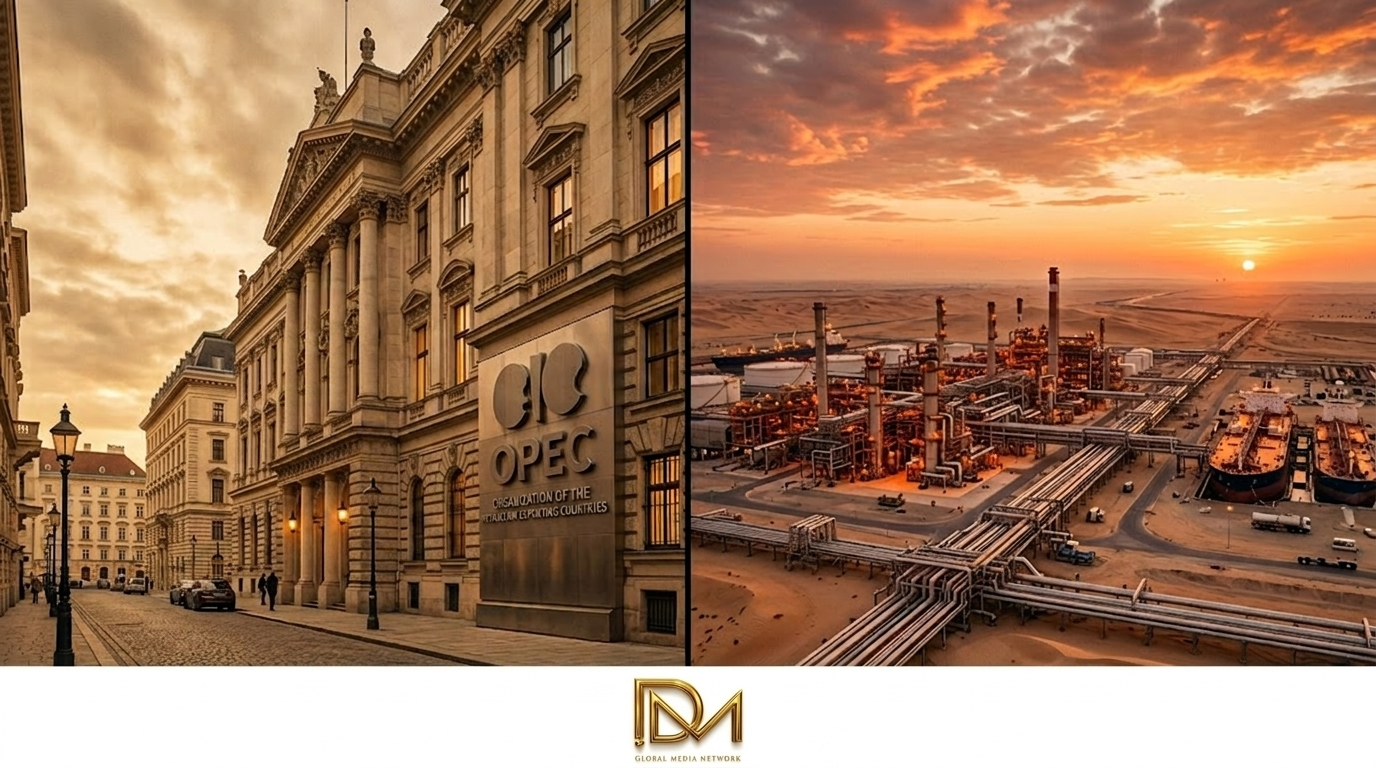
But the UAE's departure is categorically different. No previous departing member had 4.8 million barrels per day of production capacity, meaningful spare capacity, and the ambition and capital to grow further.
Losing the UAE is, as energy research firm Rystad put it, removing "a real tool from the group's hands."
OPEC will continue. Saudi Arabia's dominance ensures the organization does not simply dissolve.
But its market influence already eroded by US shale takes another measurable hit.
Countries like Kazakhstan and Iraq are now under more scrutiny: will they follow? Both have struggled with quota compliance. Both have economic incentives to produce more. The precedent the UAE has set is dangerous for OPEC's long-term cohesion.
What This Means for Business Leaders, Investors, and Markets
This is why InventionDM wrote this piece. Understanding the historical context is valuable. Understanding the business implications is essential for anyone who operates in global markets, trades commodities, manages supply chains, or invests capital.
- Oil Price Volatility Will Increase in the Short Term. With Brent crude already at $111–113 per barrel and WTI above $100, the UAE's exit removes a predictability premium that markets had priced in.
- OPEC's coordination ability is weaker; the UAE can now independently respond to price signals faster than any cartel mechanism allows. Expect more volatile oil pricing in H2 2026 and into 2027 as markets recalibrate.
- Long-Term, More UAE Oil Means Downward Price Pressure. The UAE's plan to push from 3.4 million to 5 million barrels per day of production by 2027 adds significant supply to global markets.
- For energy-intensive industries manufacturing, logistics, aviation, petrochemicals this is structurally good news for input costs over a 2–3 year horizon.
- Supply Chain Managers Must Rethink Gulf Risk. The Strait of Hormuz remains a critical chokepoint and a vulnerability.
- The ongoing Iran conflict means that even increased UAE production capacity may face export disruption risk. Businesses reliant on Gulf energy flows should accelerate dual-sourcing strategies and contract diversification.
- Investors: Watch UAE Upstream Stocks and ADNOC Partnerships. ADNOC's publicly listed entities and its international partnership portfolio (with BP, TotalEnergies, Shell, and others) become more attractive as production constraints lift.
- The UAE's upstream sector is entering an expansion phase that is directly investable.
- Geopolitical Risk Premiums Are Repricing. The Saudi-UAE fracture has deep implications for GCC (Gulf Cooperation Council) economic integration projects, Vision 2030 partnerships, and regional infrastructure investments.
- Businesses with significant exposure to both markets should seek independent risk assessments he two economies are diverging strategically.
- Renewable Energy Transition Accelerates for the Smart Money. The UAE's decision is fundamentally a bet on maximizing fossil fuel revenue before the energy transition closes the window.
- For investors, this signals that even the most sophisticated oil producers are treating their reserves as a finite, time-sensitive asset. The case for accelerating renewable energy investment as a hedge just got stronger.
What InventionDM Thinks the World Gets Wrong About This
Most headlines will frame this as "UAE vs OPEC" a conflict, a break, a rebellion. That framing is simplistic.
What actually happened on May 1, 2026 is a nation making a rational, sophisticated, long-horizon strategic decision about how to maximize the value of its sovereign resource in a world that is structurally changing.
The UAE has watched what happened to other resource-dependent economies that over-relied on collective production management while the world shifted beneath them.
It has invested in economic diversification finance, tourism, technology, and renewable energy precisely because it understands that oil is a transitional asset.
The OPEC exit is the energy strategy expression of the same philosophy.
The lesson for every business leader reading this: the institutions and frameworks designed for one era of the global economy become constraints not advantages when that era ends.
The UAE recognized this. The question is whether your organization is making the same honest assessment of which of its legacy frameworks are becoming cages.
"The UAE is not leaving OPEC because OPEC failed. It is leaving because the world OPEC was designed for no longer exists. And the UAE saw that before anyone else had the courage to say it."
— InventionDM Research Desk, May 2026