
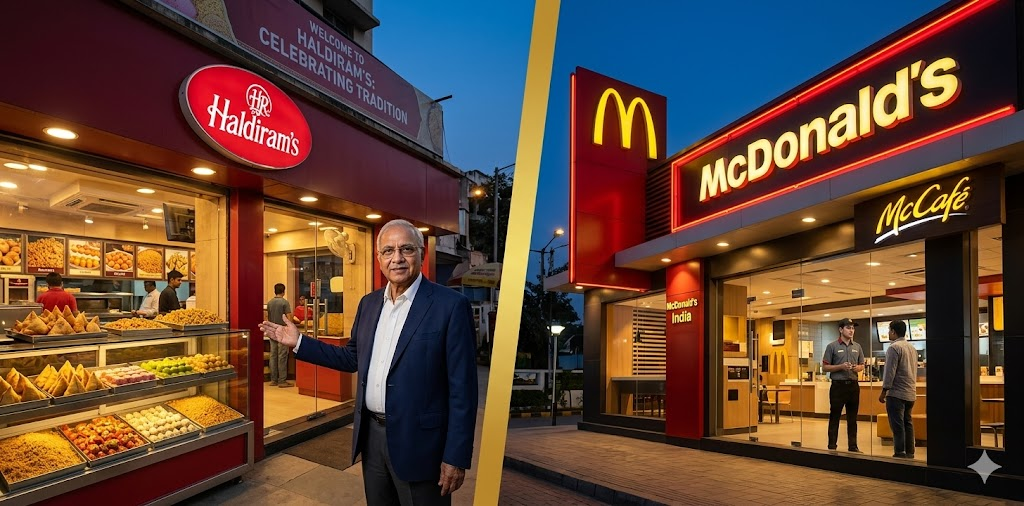
While McDonald's golden arches shine bright across Indian highways, a humble snack empire born in Bikaner's bylanes is generating nearly double the revenue — and four times the profit. Here's the untold financial story behind India's most beloved brand battle.
Haldiram's (India) |
McDonald's India (Westlife) |
Outlets 400+ |
Outlets 550+ |
Revenue (FY24) ₹12,800–14,000 Cr |
Revenue (FY24)~ ₹4,500 Cr |
Net Profit ₹1,350–1,400 Cr |
Net Profit~ ₹180 Cr |
EBITDA Margin~ 20–21% |
EBITDA Margin~ 14% |
Revenue/Store~ ₹20 Cr+ |
Revenue/Store~ ₹8.2 Cr |
In a country where the aroma of freshly fried samosas has competed with fast-food chains for decades, an extraordinary financial verdict has emerged — and it firmly favours the samosa. Haldiram's, the 87-year-old Indian snack conglomerate, is silently outpacing McDonald's India on almost every meaningful financial metric, from total revenue to per-store profitability.
The numbers are striking. While McDonald's India operates through its franchisee Westlife Foodworld and runs over 550 stores across the country, Haldiram's generates nearly three times the revenue with fewer outlets. The Indian brand earned between ₹12,800 crore and ₹14,000 crore in FY2024, while McDonald's India clocked approximately ₹4,500 crore. More telling is the profit picture: Haldiram's net profit stood between ₹1,350–1,400 crore, compared to McDonald's India's roughly ₹180 crore.
"Haldiram's is not just a snack brand — it is a cultural institution. And now, the numbers are finally catching up to that truth."
A Family Recipe That Became a Financial Empire
_____________________________________________________________________
Haldiram's began in 1937 when Ganga Bishan Agarwal — affectionately called "Haldiram" — started selling bhujia from a small shop in Bikaner, Rajasthan. What followed is one of India's most remarkable bootstrapped success stories. Without venture capital, without a single IPO, the brand expanded organically through the sheer power of taste, trust, and tradition.
Today, Haldiram's is not just a retail chain — it is a diversified food empire spanning packaged snacks, ready-to-eat meals, sweets, restaurants, and exports to over 80 countries. Its valuation has crossed the $10 billion mark, cementing its place among India's highest-valued private companies. Temasek, Singapore's sovereign wealth fund, recently acquired a 10% stake for approximately ₹8,500 crore — a vote of confidence that echoed across global investor circles.
Why Per-Store Numbers Tell the Real Story
________________________________________________________________________
Raw revenue comparisons can be misleading — but per-store profitability cuts through the noise. Haldiram's generates approximately ₹20 crore or more in revenue per outlet, while McDonald's India earns around ₹8.2 crore per store. This gap is not just about footfall — it reflects fundamentally different business models. Haldiram's stores serve as hybrid hubs: restaurant dining, packaged product retail, and takeaway sweets all coexist under one roof, multiplying revenue streams from a single location.
McDonald's, on the other hand, has faced persistent margin pressure in India. In the third quarter of FY2025, Westlife Foodworld reported a 59% drop in quarterly profit, driven by surging commodity costs — including oil, coffee, and cocoa — and rising marketing spend. Despite a 9% increase in revenue, inflationary headwinds squeezed net profit down to just ₹7 crore for the quarter. The EBITDA margin dropped to approximately 14%, compared to Haldiram's robust 20–21%.
The McDonald's Counterplay > Scale and Brand Power
_________________________________________________________________________
It would be unfair to write off McDonald's India. The golden arches retain enormous brand visibility, a loyal urban customer base, and the backing of one of the world's most powerful QSR (quick service restaurant) corporations. With over 550 outlets and aggressive new store additions each quarter — Westlife opened 15 new restaurants in Q3 FY25 alone — McDonald's is betting on scale as a long-term lever.
The brand's pivot toward affordable "budget menus" has also shown early signs of working. Same-store sales grew 2.8% in recent quarters, and investor sentiment remains optimistic despite the profit pressures. McDonald's India is also uniquely positioned to benefit from India's expanding urban youth demographic, whose affinity for quick, Western-style dining experiences continues to rise.
What Haldiram's Gets Right — and What It Signals for India
__________________________________________________________________________
Haldiram's success is a masterclass in leveraging cultural resonance as a business moat. Its products don't need celebrity endorsements or aggressive discounting to drive demand — they are woven into the fabric of Indian festivities, daily snacking habits, and emotional memory. Diwali without Haldiram's sweets, or a train journey without its bhujia, feels incomplete to hundreds of millions of Indians.
Furthermore, the brand's compounded annual growth rate of 16–17% over recent years demonstrates that this is not a static legacy story — Haldiram's is actively expanding, innovating its product lines, and growing its international footprint. With exports contributing 10% of revenue, it is steadily establishing itself as a global ambassador for Indian snack culture.
The broader message this financial comparison sends is profound. India's domestic consumer market — when served by brands that deeply understand local tastes, sensibilities, and price points — can rival and surpass globally established giants. As India's middle class grows and premiumises, companies like Haldiram's are extraordinarily well-positioned to capture that wave.
Looking Ahead > An IPO on the Horizon?
_________________________________________________________________________
Industry watchers are closely tracking discussions around a potential Haldiram's IPO. Board-level conversations about listing are reportedly underway, though no timeline has been officially confirmed. If it proceeds, the IPO could be one of India's largest in the consumer goods space, giving retail investors their first direct stake in this iconic institution.
Whether or not the IPO materialises, Haldiram's financial dominance over its multinational competitor is already a landmark moment — not just for Indian business, but for the global narrative around homegrown brands challenging foreign giants on their own turf.
The samosa, it turns out, is not just comfort food. It is a ₹14,000 crore annual statement about the power of staying true to your roots.