
The Teacher Who Should Have Stayed Home
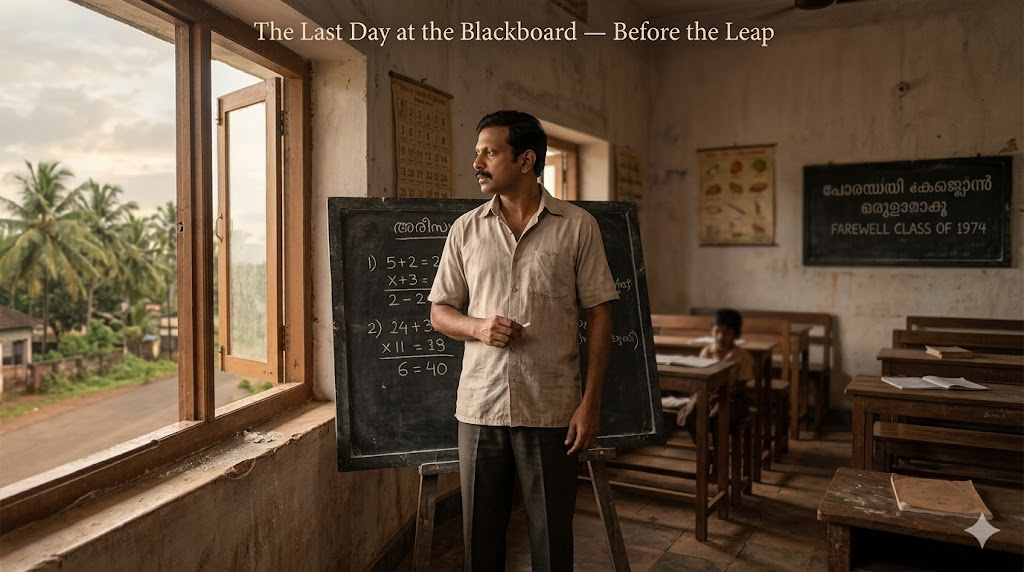
In a small town in Kerala, there was a man who could have lived a perfectly comfortable life. He had a degree. He had a job — a respected one, in fact. He was a teacher. And in the India of the 1970s, a teacher was someone who had made it.
But something about the classroom didn't satisfy him. Not because he didn't love learning — he did, deeply. But because every time he looked at his students, he saw potential that the world was going to underpay.
He saw his own potential the same way.
So he did what made absolutely no logical sense to everyone around him: he quit.
" A secure job is the enemy of a great life. You can't grip a dream with a hand that's already full. "
He walked away from the blackboard. He walked toward the Gulf. Toward uncertainty. Toward the Middle East where young men from Kerala were beginning to find fortunes — or lose everything trying.
Nobody gave him a guarantee. Nobody gave him a map. He had only one thing: an eye for value, a talent for trust, and a community that believed in gold.
Where Gold Was More Than Jewellery
In the Gulf during the 1980s, gold was not decoration. It was currency. It was security. It was how families survived downturns, how weddings were celebrated, how women secured their own financial independence in cultures where bank accounts weren't always theirs.
He understood this instinctively. Gold, for the people of Kerala and the broader Indian diaspora in the Gulf, was emotional. Sacred. It wasn't just a product — it was a promise.
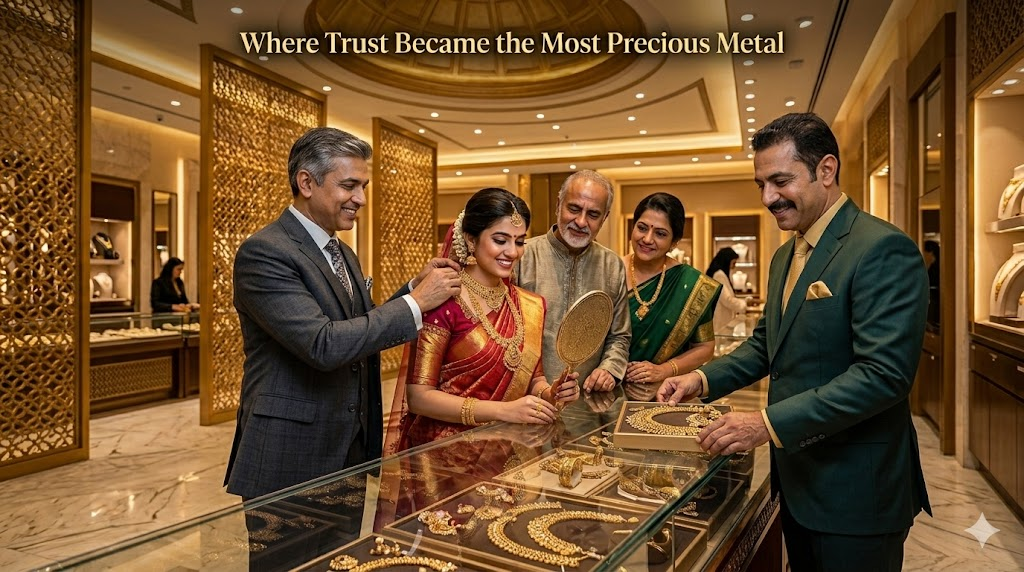
He opened a small jewellery shop. No empire. No investors. Just a rented space, a modest inventory, and the radical belief that if you treated customers with honesty, they would come back. And they would bring everyone they knew.
Trust as a Business Model
At a time when gold retail was rife with impurity scandals and deceptive pricing, he made a bet that very few businessmen of that era were willing to make: radical transparency.
He priced fairly. He tested purity honestly. He gave receipts that meant something. He trained his staff to treat every customer — rich or modest — with equal dignity.
The result was not just customers. The result was loyalty.
In a community where word travels fast and trust travels faster, his single store became the most talked-about jeweller in the neighbourhood. Then the city. Then the region.
" Don't sell gold. Sell trust. The gold is just the medium. "
The Leap That Defied Logic
By the early 1990s, he had built a solid business. A comfortable life. A reputation. The sensible thing to do would have been to consolidate. To enjoy the fruits. To protect what he had built.
Instead, he did the thing that separates the merely successful from the truly legendary: he decided to scale.
He returned to Kerala and opened what would become the foundation of a retail revolution in Indian gold jewellery. He didn't open just another showroom — he opened an experience. Thousands of square feet. Hundreds of designs. Organized sections. Trained staff. A price tag for everything, printed clearly where everyone could see it.
India's jewellery industry had never seen professionalism at this scale. It was the retail equivalent of someone turning on a light in a room that had been dim for decades.
India Wasn't Ready. Then It Was.
Early critics said it was too much, too fast. That Indian families preferred their neighbourhood jeweller who knew them by name. That gold retail was a relationship business, not a showroom business.
He knew both things could be true. So, he built something that felt like a showroom but operated like a relationship. He hired local staff. He participated in community events. He made Malabar Gold feel like it belonged to the people who shopped there.
Within a decade, the critics were silent. Because the numbers were speaking too loudly.
The Empire Written in Gold
His name is M.P. Ahammed — Chairman of Malabar Gold & Diamonds, the largest gold retail chain in India and one of the largest in the world.
From that first small Gulf showroom, he built something that the global jewellery industry studies, benchmarks against, and sometimes simply cannot believe.
📊 MALABAR GOLD & DIAMONDS — BY THE NUMBERS (2024–25)
- Annual Revenue: ~$8 Billion USD (one of world's top 3 jewellery groups)
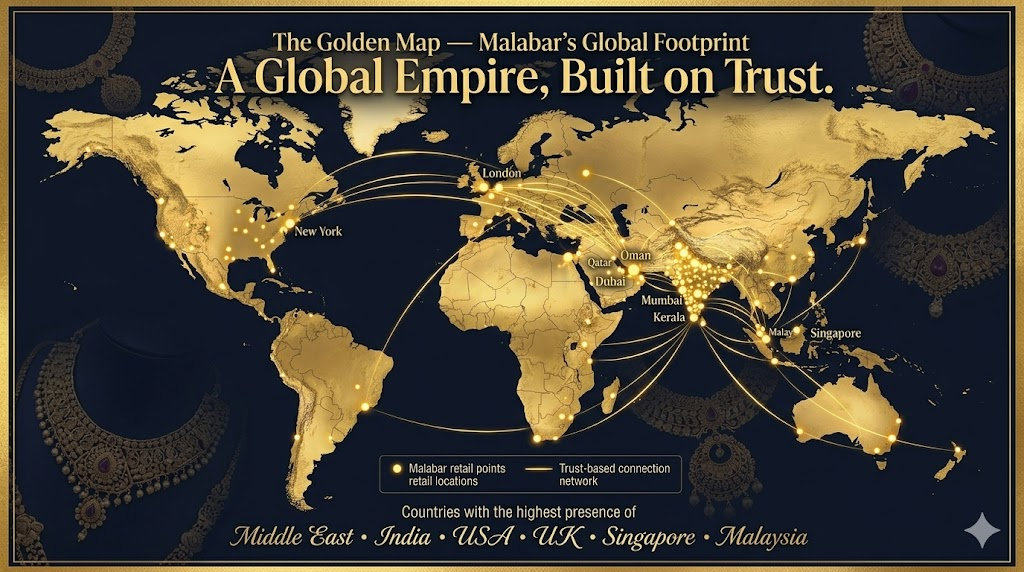
- Global Showrooms: 350+ across 12 countries
- Countries: India, UAE, Qatar, Kuwait, Bahrain, Oman, USA, UK, Singapore, Malaysia, Canada & more
- Employees: Over 12,000 people worldwide
- India Network: #1 Jewellery Retailer in India by number of stores
- Net Worth (M.P. Ahammed): ~$3+ Billion USD
The Philanthropist Behind the Billionaire
M.P. Ahammed is one of those rare industrialists whose public profile is almost inverse to the size of his impact. He is not the loudest voice in the room. He does not seek headlines. And yet, the lives he has touched run into the hundreds of thousands.
Through Malabar Gold's CSR wing, he has funded hospitals, educational institutions, scholarship programs, and infrastructure development across Kerala and beyond. His investments in education alone have sent thousands of young people — who otherwise had no path forward — into careers, colleges, and confidence.
He speaks often about one belief that drives him:
" Business is not just about making money. It is about making meaning. Every rupee you earn is borrowed from the society that allowed you to earn it. "
That philosophy is visible in every policy his company practices — from fair employment practices to sustainable gold sourcing to community reinvestment programs that are remarkably transparent for a private company of this size.
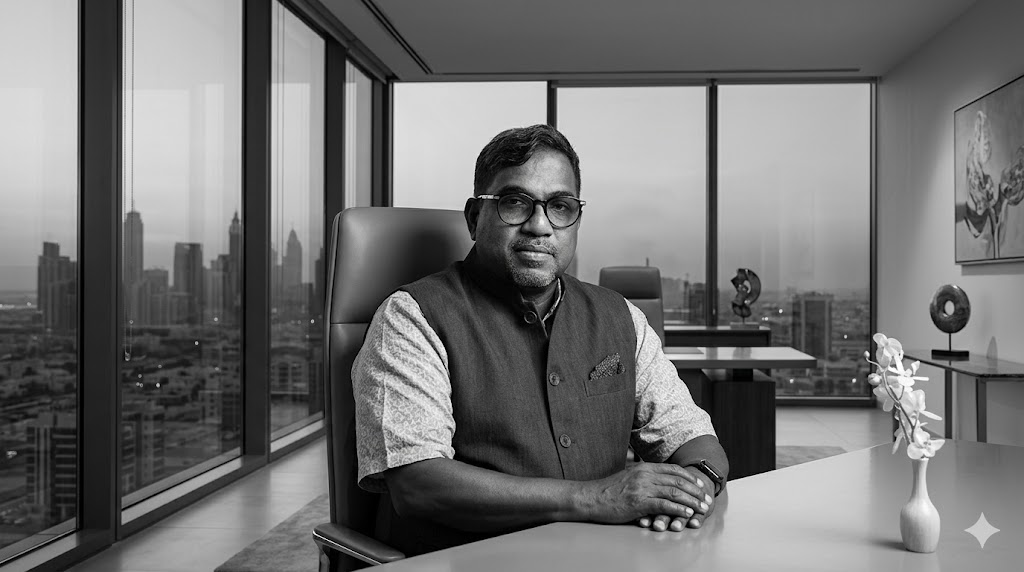
The Chairman — M.P. Ahammed, Portrait of a Builder
What Gold Taught Him About Life
Gold, as M.P. Ahammed understands it, is not just a commodity. It is a lesson in value — in the difference between price and worth, between what something costs and what it means.
His life reads like a metallurgical process: pressure applied, heat endured, impurities removed, until what remains is something refined, strong, and rare.
He started as a teacher. He became a merchant. Then a builder. Then an institution. And through it all, he remained — by every account of those who know him — simply a man from Kerala who believed that if you did things right, the world would notice.
The world noticed.
" Gold doesn't lie. It is what it is. Be what you are — with full purity — and the world will always find value in you. "
Today, when you walk into a Malabar Gold & Diamonds showroom — whether in Lucknow or London, in Dubai or Dallas — you are walking into a monument built by a man who quit a stable job, crossed a sea, and decided that the only ceiling he would accept was the one above the sky.
There isn't one.
INSPIRED BY THIS STORY?
Visit inventiondm.com for more untold stories of visionaries who changed the world.